October 07, 2026


Advent is four weeks of waiting, and waiting with a three-year-old is a particular kind of spiritual exercise. They will ask whether it's Christmas yet. They will nearly tip the candle over. They will answer your careful question about hope with a long story about a dinosaur.
That's fine. The point of a family Advent devotional is not a beautiful scene you could photograph. It's ten or twelve minutes a day when your kids hear, in your voice, that God keeps his promises. Everything below is built to fit inside that window.
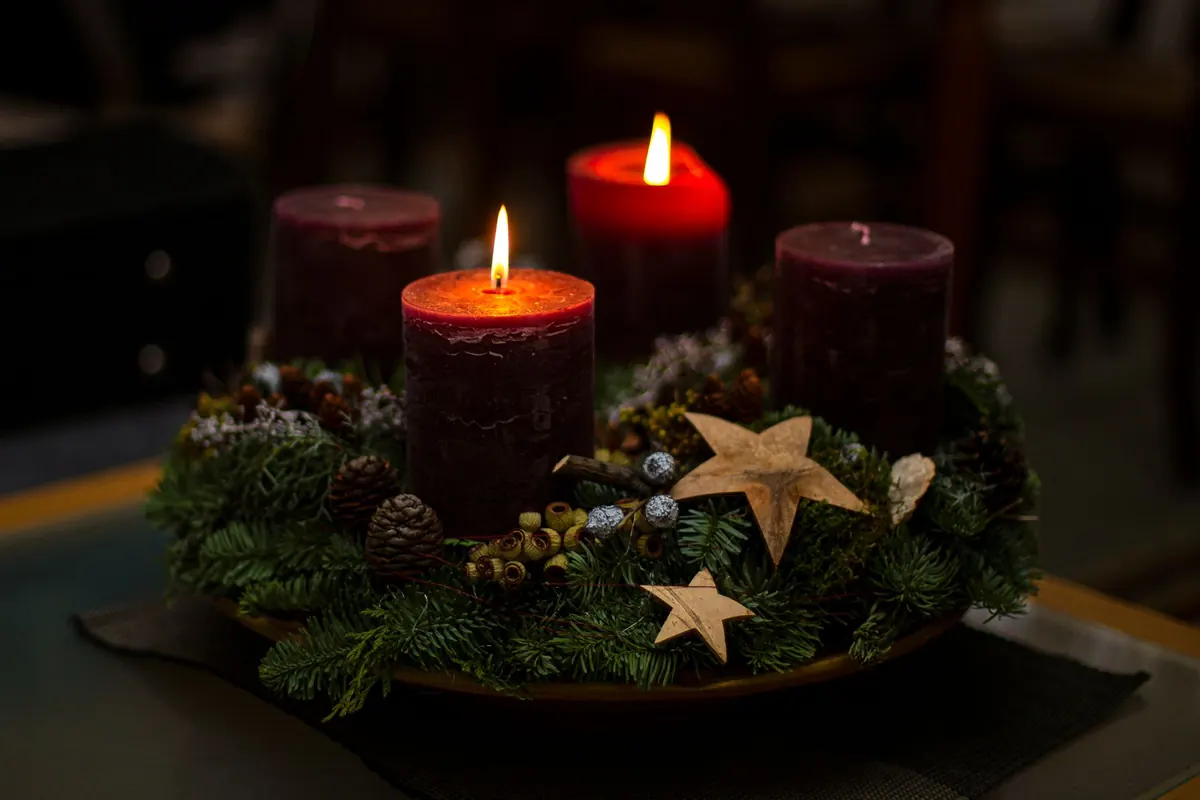
You need five candles, a Bible, and a willingness to repeat yourself four times in a row. The readings are short on purpose. The questions are simple on purpose. If a night falls apart, blow out the candle and try again tomorrow.
Keep the setup boring and repeatable so you spend your energy on the reading rather than the logistics.
Pick a time and hold it: right after dinner, or just before bedtime stories. Keep the wreath where you already gather. If you have toddlers in the "we look, we don't touch" stage, use battery candles for the first weeks and save real flames for Christmas Eve.
Light one candle and say: We light this candle for hope. God's people waited a long time for the promised Savior, and God did not forget them.
Read Isaiah 9:2 and 9:6 slowly. For very young children, paraphrase: "Long ago, God promised to send a light into the dark. That light would be a baby, and his name would be Wonderful Counselor, Mighty God, Everlasting Father, Prince of Peace."
Ask:
Then do one small thing: set a single electric candle in a window, or have each child draw a star and tape it to the fridge. Waiting is easier when you can see something.
Light two candles and say: We light these candles for peace. Tonight we remember the shepherds, who were doing ordinary work in the dark when God sent a whole sky full of angels to tell them good news.
Read Luke 2:8–14.
Pray one sentence and let the children add their own. "Jesus, thank you for being our peace. Help us be gentle with each other tonight."
Light the pink candle along with the first two. This is the week the mood turns. The waiting is more than half over, and the candle itself is a small celebration.
Read Luke 1:46–49, Mary's song. Young children usually like hearing it as Mary being so happy she had to sing out loud.
Optional: sing one verse of "Joy to the World" together, badly and loudly. It counts.
Light all four candles. Read Matthew 1:20–23, where the angel tells Joseph to name the baby Jesus, "because he will save his people from their sins," and Immanuel, "God with us."
Light the white center candle last, after all four others are burning. Read Luke 2:1–20 aloud, or John 1:1–5 if you want something shorter and quieter.
Let the last candle burn while you open one gift or sing one carol. Ending on the light is the whole point.
A few habits make the difference between a tradition your family keeps and one you quietly abandon by December 9.
If your family is in a hard season — a death, a deployment, an illness, a difficult pregnancy — cut it to the bone. Read one verse, light one candle, say "God is with us," and go to bed. That is a complete Advent devotional. God is not grading the production value.
Twelve minutes a night, four weeks, five candles. Do that and by Christmas Eve the words will be in your children's ears: hope, peace, joy, love, and a light that the darkness has not overcome.
Reflections on faith, hope, and the cross.
Copyright © 2026 The Cross Journal. All rights reserved. The Cross Journal.